




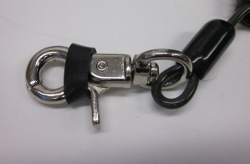
B&D Ski Leashes
The backcountry ski touring leash from B&D is designed to alleviate the need to detach and attach your skis while putting on your climbing skins. The 1980s phone-style elastic cord stretches enough so you can lift your skis to put on your skins. This means you won’t lose your ski during transitions. It also allows for more slack in the line when your bindings release in a fall. Last but certainly not least, the leashes come with a breakaway feature to help prevent your skis from pulling you under in an avalanche. With enough force, a link in the chain brakes so you can swim to safety (hopefully, *gulp*).
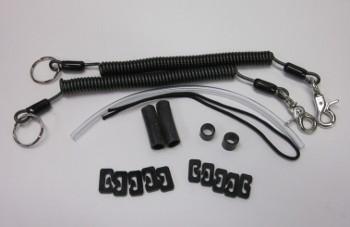
- Coiled cord dissipates energy in a fall, reducing peak force on the leash.
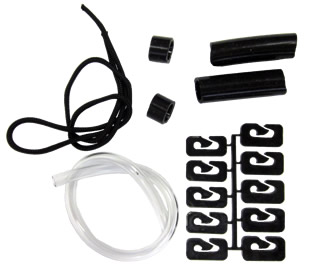
- Two fuse links included that will break at either 40lb or 60lb of force.
- Also comes with Vinyl tubing to protect the cord in wear areas.
- Cords extend to 6 feet, which may keep your sharp edges away.
- Snap-hook is easy to operate with gloves for quick operation.
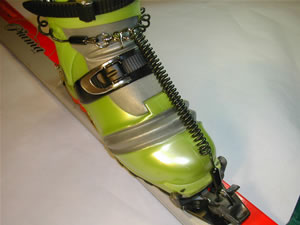
- Cord can be wrapped around your boot to stay out of the way.
Related Products


Questions & Reviews
2/2/2026
 Meaghan Flagg
(used product regularly)
Excellent product- these eliminate all the annoying parts of traditional leashes. I love that I can transition (or crawl over logs/creeks/etc) without having to unclip. Transitions on steep icy slopes are way more secure with these leashes. The break away clip works as intended- it has never accidentally disconnected, but broke appropriately under significant load. Highly recommended.
Comment on this review:
The best leashes I've found.
First off - why leashes: brakes often don't work in the backcountry (they don't stop skis in light pow or when the slope is steep enough).
I've had these leashes on my salomon mtn explores and 4frnt hojis for 8 years combined.
These leashes are long enough to pop out for a scramble over a ridge or to keep clipped during a transition and the fuse link snapped as designed when the ski caught on a tree, but I kept falling, reducing risk of injury on my leg.
They're not the lightest, but you can keep them off when skinning. The only part to fail over time was the rubber security band, but they included spares.
Comment on this review:
5/26/2025
How would these leashes attach to an ATK RT 11 EVO toe piece?
5/27/2025
Hi Kent,
I would use the piece of cord and the vinyl tubing that comes with the leashes to make a loop through the hole on each toe lever! You can connect the leash from there using the breakaway links.
I would use the piece of cord and the vinyl tubing that comes with the leashes to make a loop through the hole on each toe lever! You can connect the leash from there using the breakaway links.
Answer this question:
11/30/2024
Will these work with g3 ion 12 bindings?
12/2/2024
Hi Christine,
The Ion has a slot in the toe piece to attach a leash. The ring included with these might fit fine, but 2mm cord would work best. The G3, marker, Dynafit, Plum, and any that have a flexible attachment ring will all work well.
The Ion has a slot in the toe piece to attach a leash. The ring included with these might fit fine, but 2mm cord would work best. The G3, marker, Dynafit, Plum, and any that have a flexible attachment ring will all work well.
Answer this question:
2/11/2024
I need more vinyl tubing. Where do I get some?
2/12/2024
Hi Frank! Unfortunately, we do not have any tubing stocked. You could likely find additional vinyl tubing at a local hardware. Thanks!
Answer this question:
1/21/2024
I order the B&D leash for my Marker Alpinist 10 binding. Now I'm sitting in front of my skis and cannot figure out how to attache the leash to the binding. Does anyone have the same bindings and can share a suggestion? I see no holes or loops that I could put the string through.
1/22/2024
Graham,
There are slots on either side of the toe lever that could be threaded with thin cable or cord, or you could attach them to the riser if they'll only be used for alpine.
There are slots on either side of the toe lever that could be threaded with thin cable or cord, or you could attach them to the riser if they'll only be used for alpine.
1/23/2024
Those holes, when the boot is within the toe part, pretty much disappear so I cannot thread it through there (for these leashes it would be string plus vinyl tubing).
Answer this question:
11/15/2023
Where is the best place to loop an attachment point for a pair of ATK Crest 10s? The toe lever has a hole/cut out, is that appropriate?
11/16/2023
Hi Chris, the hole on the side of the toe lever is a great place for a leash. That's where ATK's own leashes attach.
Answer this question:
3/6/2023
Kate
(used product regularly)
I've used these for several (9ish) years - still the original pair. I simply wrap around leg above boot.
Easy to attach, can apply/remove skins with ski attached easily.
Gives a lot of confidence when ski on/off on steeper slopes.
Only downside is be careful not to catch on footrests on chairlifts - wrap to the inside of your leg assists with that.
Recommending some friends to get them now
Easy to attach, can apply/remove skins with ski attached easily.
Gives a lot of confidence when ski on/off on steeper slopes.
Only downside is be careful not to catch on footrests on chairlifts - wrap to the inside of your leg assists with that.
Recommending some friends to get them now
Comment on this review:
5/23/2022
Do these leashes work with the fritschi tecton 12 and tecnica cochise 120?
5/24/2022
Hi Liam. These are incredibly versatile. I don't have a Cochise here but you'd be hard-pressed to find a binding/boot combo these won't work with.
Answer this question:
1/12/2022
Do these come as a pair, or do I need to order two for two skis?
1/12/2022
Hey John, they come as a pair.
Answer this question:
1/12/2022
How much does each of the leashes weight?
1/12/2022
Hello Álvaro, a single leash weighs 46 grams.
Answer this question:
1/3/2022
Can these be attached to the Marker Alpinist? I haven't used leashes with them, but supposedly the attachment point for the Alpinists is really small/hard to thread after having mounted the binding.
1/4/2022
To answer my own question, it looks like just buying a thin stainless steel loop (a quick search for "wire loop" on Amazon brings up options; there may be an option form SkiMo, but I haven't found it yet) should bridge the compatibility gap. I plan to order a pair of these today and will update this post if I run into any issues!
1/14/2022
Hey Daniel, I'm in the same situation. Did they end up working for you?
1/16/2022
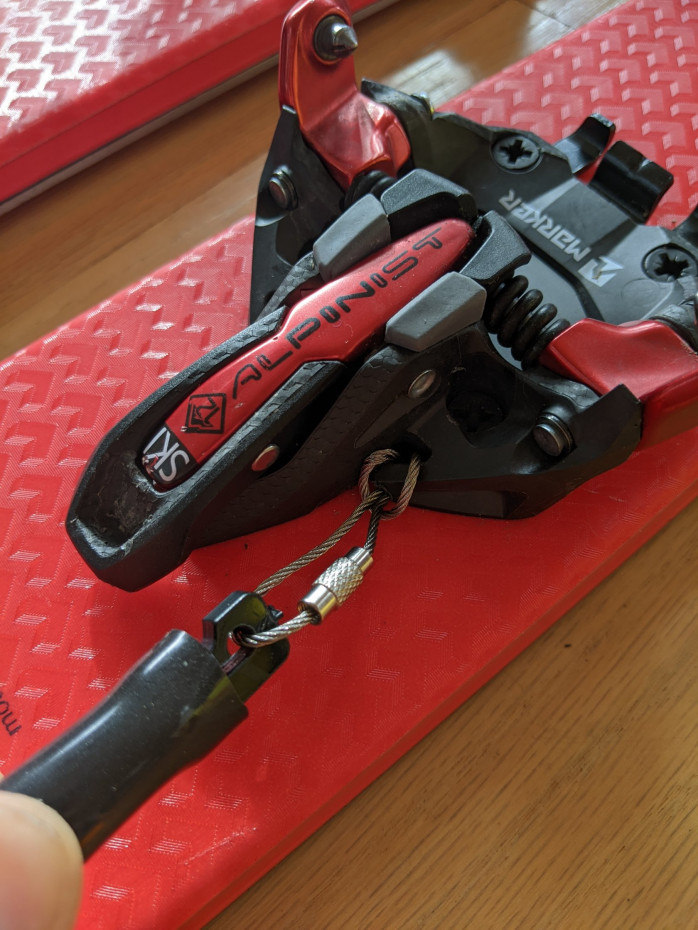
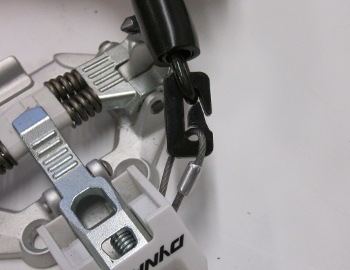
Yep, I just got everything set up this morning. You do need a thin wire loop (1.5mm worked for me). Importantly, you can't thread the wire loop straight through the hole on the toe of the Alpinist while the binding is mounted. However, you can kink the steel cable, pull it through using a pick, and put a girth hitch in it. I think the attached picture adds some clarity. To emphasize: I do not think I could have gotten the steel cable through the binding without the pick. The only downside I see to this is that there's a little fraying of the steel cable where I pulled on it with the pick, but I'm pretty confident that it's still way stronger than the BND breakaway plastic bits.
12/27/2022
This thread was really useful! Instead of a SS wire loop, I used 1.5mm braided Kevlar cord (250lb tensile strength) with a girth hitch through the Alpinist mount point and a triple fisherman's knot to join the ends. Not sure about the long-term durability, but I was a bit worried about the barrel connector in Daniel's solution (i.e., pulling the cable out of the barrel).
Answer this question:
Great leashes and 100x better than any leash included with bindings. You can put it on in the morning and in most cases won't need to unclip it all day.
It is strong, durable and long. My boots (travers cs) do not have a connection point so I ended up putting a keyring on the tongue pull tab on the boot liners. This adds a little bit more distance compared to a normal connection point and eliminates the concern that the leash will be too long as stated in lance j's review. No need to wrap them around the cuff, which I haven't tried myself, but looks and sounds annoying and frustrating.
Overall a solid upgrade and definitely one of the highest improvements per dollar I've spent on ski gear!
Comment on this review:
12/30/2020
Can these be attached to just about any binding? Looks like they clip easily to a Dynafit which I’ve got on my touring setup. I’d like to use them on my Marker Griffin 13 ID bindings that I’ve got on my inbound setup so I don’t lose my skis in the pow when I’m getting a little too sendy. Thanks!
12/31/2020
Hey Madolyn, yes that is correct. If there isn't a specific spot to clip on the binding, quite often you can just get some small diameter cord and loop it around something on the binding to have a spot to clip.
Answer this question:
12/12/2020
how long are theses when coiled please
12/12/2020
Hey Dave,
Great question! The entire leash, including the hardware, is just about 10''. Just the coil is right around 7".
Great question! The entire leash, including the hardware, is just about 10''. Just the coil is right around 7".
Answer this question:

For starters, I am not a fan of ski brakes. I prefer a leash - it makes me more confident that my ski is going to stay a ski and not turn into a scavenger hunt. After a day on the stock Dynafit leashes that came with my Speed Radicals, I decided that I wanted a bit more length and versatility with the leash. Fortunately, I'd seen these leashes while looking on B&D's website for some toe riser plates for the same bindings (before SkiMo.co carried B&D, otherwise I would have ordered from you guys...).
The pros of the B&D leashes are that they have a break link that will separate you and your skis in the event of an avalanche, and that they have plenty of length to keep you out of harm's way if you yard on the descent. The long and short of these leashes (not sure whether the pun was intended or not) is that they work, and they are a nice upgrade from the Dynafit leashes in my opinion.
The only down side of the leashes is that they are long, so if you prefer to clip to the front of your boot, you'll end up with a lot of extra leash flopping around, and if you leash around your cuff, I keep getting them stuck in my walk/ski lever. Neither situation is awful, and if I just stopped and thought for a second as I was attaching the leashes when I'm in walk mode at the bottom of the mountain, then the second issue would be solved.
Comment on this review:
Showing 1 to 16 of 16
Earn store credit by writing reviews. Learn more.
Overall rating:
Add a photo
